Saturday, November 28, 2020
Republicans navigating in populist waters
COVID (again) Body count vs mortality
Thursday, November 12, 2020
Sweden worst in Digital Government?
Monday, September 28, 2020
Doctors per habitant
In these COVID times, the comparison beteen different countries health-systems is a trending topic.
The comparison is not easy as there is no easy KPI to measure.
For instance, the graph below compares number of doctors and nurses per habitant, but what good is a lot of doctors if they don't have the right infrastructure?
Possibly, life expectancy might be one of the best ways to measure the quality of the health in its broadest sense (also the prevention of deaths due to accidents etc..).
Hopefully there also is some kind of correlation between life quality and life expectancy.
Spenditure on health system as part of GDP might also be an indicator of the importance the society gives to the healt system... but, in that number you cannot see if the money is spent efficiently.
Anyway, having said this, that there is no single KPI to use to measure the quality of different health systems, there are amany KPI's that each one tells a part of the complete picture.
In this case, as mentioned, I have found the number of doctors and nurses per capita in different countries.
Friday, June 12, 2020
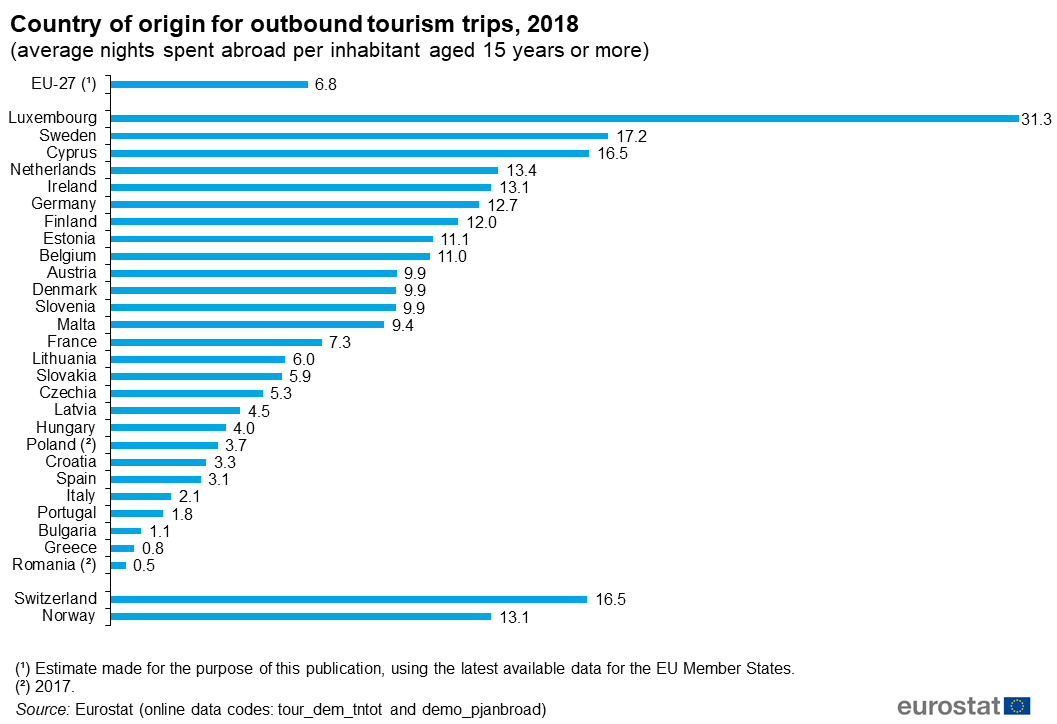
Swedes, a traveling people

Alcohol related deaths
I was not able to find good info from recent years, so here are some old data.
Sunday, April 19, 2020
COVID - mobility
So, to my surprise, it seems like many swedes would like to be forced to stay home rather than stay home voluntary.
The comparison normally is with Finland or Norway, stating how successful they have been in their fight aganst COVID (i.e., that they have less deths due to COVID19 at this point).
My opinion normally is that we will not know which is the "best strategy" until much later... having "better" numbers now does not mean that it will remain so.
Looking at the day by day numbers at this point is like deciding who is the winner in a marathon after 3 km.
If a country, to great economic cost, manages to delay the infection of its habitants... but at one point has to let the economy work again (reality is a bitch) then... what has been won? The virus is still out there. People will still get infected.
Only if there is a vaccine available after the lockdown (probably not) or a much improved treatment has been discovered (this is of course happening, but how much better will it be in one month? Maybe we will have to wait 3 months before the difference is really notable?) will this strategy be succesful
So, as far as I understand it, the Swedish strategy to...
- protect specific groups and...
- "control" the infection rate ("R") so that the hospitals never get overloaded (i.e., all sick persons shall be able to get the best treatment available)
... is not necessarily a bad strategy.
I am the first one to recognize that I can be wrong, but... as I said, I am a strong believer that we will not know that until after this has passed.
Still, a part from COVID-19 and its impact... I find it tremendously interesting (but scary) to see what happens with different countries based on their different strategies.
So, as a starter, I looked around to see if there was any manner to check the direct impact of the different strategies (mainly voluntary vs imposed by law in diferent degrees).
And, lucky me... Google has an excellent service to meassure the mobility in different areas.
Here are the "mobility" changes in "retail & recreation" areas in some countries.
As can be expected, the mobility in Sweden has decreased less than other countires. Among the compared countires, Finland is the second country with less mobility change.
- The three countries with strictest lockdown (Spain, Belgium) also happens to be the countries with most COVID19 detahs (but that's beside the note for this post)
What is striking is how second line from the top (Denmark) actually is not as different than Sweden (and still they consider Sweden as a watching a horror movie).
The third line from the top is Finland. This is the country that many people seems to consider the utter success in the COVID fight. Or, at least, a major success vs Sweden.
Though the COVID impact is not the focus in this post, it is still interesting to see that countries with much stricter lockdown (almost all of them) has higher death rate than Finland... This fact should make it clear that there is more, much more, to this than only "strict lockdown".
What I actually am curious (scared) to see, is which will the impact be in countries that closes down 90% of its activity during months?
- How many companies will be forced to close?
- How many people will get unemployed?
- How many divorces will there be?
- Will the family violence increase? Will there be deaths?
- .....
I am sure that this will be the input for many, many economic, sociologic, studies in the future. But, remember... you saw it here first 😉
//Roland
Sunday, March 22, 2020
COVID19
Additional read: COVID-19 deaths and cases: how do sources compare?